We reply in English, 9 am to 11 pm (Spanish time), every day.
Home alarms in Valencia: protected wherever you are.
Offer
€24.90/month
for the first 12 months. VAT, equipment and installation included.
Offer ends 30 November
Valencia is one of the Spanish cities where the English-speaking population has grown fastest in recent years, with many people living in flats in Ruzafa, El Carmen and Benimaclet, or near the beaches at Cabanyal and Malvarrosa.
Most homes are flats, a lot of them in older buildings where a street door leads straight to the stairs and the flat door is the main barrier. Ground-floor and first-floor flats on narrow streets also have windows within easy reach.
Neighbourhoods
Where we install in Valencia
Every part of Valencia is covered. These are the areas we are asked about most, and what the homes there are usually like.
Ruzafa
A lively central neighbourhood of older apartment buildings, cafés and markets, popular with international residents.
El Carmen
The old town, with narrow streets and historic buildings where many flats have street-level access or balconies within reach.
Benimaclet
A former village near the universities, with low-rise buildings and a population of students and young professionals.
Cabanyal and Malvarrosa
The seafront neighbourhoods, with colourful old townhouses in El Cabanyal and apartment blocks along the Malvarrosa beach.
Eixample
Elegant blocks of older flats with grand entrances and shared staircases, just south of the old town.
Campanar
A residential area to the north-west with modern apartment buildings, many with communal pools.
The right set-up
The right alarm system for your home in Valencia
The free survey decides the final kit, but this is what we usually fit in Valencia, depending on the kind of home.
Apartments
A Valencia flat is covered by the Kit Tranquilidad: a sensor on the entrance door, camera detectors in the hall and living room, the keypad and the siren, plus sensors on reachable lower-floor windows.
Townhouses
Cabanyal townhouses open straight onto the street and often have a patio or roof terrace. Each door gets a sensor, and a camera detector covers the ground floor.
Houses outside the city
Houses with gardens on the outskirts or along the coast are best with the Plus kit and an outdoor detector.
Local advice
Three things that help in Valencia
Older buildings
The wireless kit goes in without building work, which helps in older blocks and listed buildings.
Renting
Ask your landlord first. Most agree, because the equipment leaves no marks to speak of.
Ground-floor windows
If a window can be reached from the street, it gets a sensor.
Local guide
Protecting a home in Valencia: what we have learned
Most of the English speakers who contact us in Valencia live in the city and rent or own a flat. The concerns are practical: whether the landlord will agree, whether the kit needs building work, and whether the alarm will still work if the building’s internet goes down. The standard kit is wireless, goes in without works, and also connects over 4G/5G.
Older buildings in Ruzafa, El Carmen and El Cabanyal deserve particular attention at street level. Ground-floor and first-floor flats often have windows or balconies within easy reach, and those get their own sensors. Higher up, the front door is the main way in, and a sensor there plus a camera detector in the hall does most of the work.
Summer is when Valencia flats are left empty longest, often for most of August. Arm the alarm before you leave, give a tag to a neighbour or friend who can check on the place, and keep the app on your phone so you know straight away if anything happens.
It is also worth talking to your building’s community of owners if you are planning cameras. The technician positions any camera to cover your own flat only, in line with Spanish data protection rules, so the shared stairs and the street are not filmed. The detectors inside your home do the real work: they see anyone who comes through the door, send the images to the monitoring centre, and let a person decide whether to call the police. And because everything is arranged in English, you know exactly what you are signing, from the monthly fee after the first year to the minimum term.
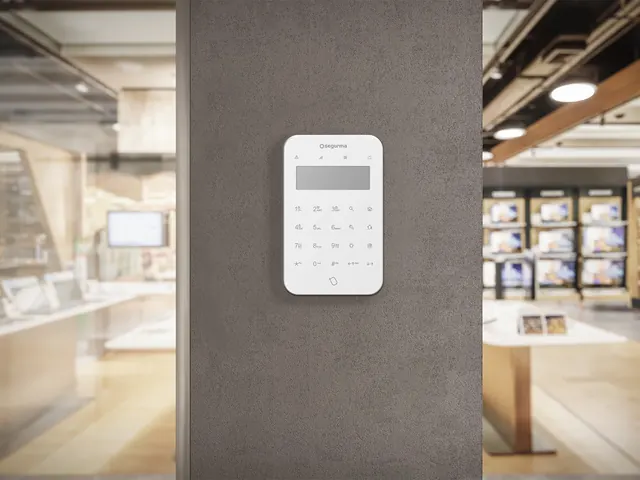
The keypad goes just inside the door you use most. A tag or the app does the rest.
Living with an alarm in Valencia
Through the year, and when nobody is home
Through the year in Valencia
Valencia is lived in all year, but flats are often left empty during the long summer holidays, around Christmas and on trips back to the UK. August in particular sees whole buildings half empty, which is exactly when a monitored alarm earns its place.
Squatters
Empty flats in older buildings can be targeted by squatters, and Valencia has seen its share of cases. In Spain, if the police are alerted while someone is breaking in, they can act straight away; once people have settled in, it usually means going to court. A camera-verified alarm gets the alert out during the intrusion itself.
Getting it installed
Valencia airport is about 20 minutes from the centre. If you are away, a neighbour or family member can let the technician in. Installation is usually arranged within 1 to 5 days of signing up.
How it protects you
If a burglar breaks into your home in Valencia
The same thing happens whether you are asleep in the UK or at the beach down the road.
1
A sensor is triggered
A door opens or a camera detector picks up movement, and the images go to Segurma’s monitoring centre.
2
A person checks
An operator looks at the images before anyone is called, so false alarms do not send the police to your door.
3
The police are alerted
With the images as evidence: a report from a licensed security company, not a vague call from a neighbour.
4
You are told at once
The alert reaches your phone wherever you are, and the siren lets the intruder know they have been seen.
While you are away
Peace of mind in Valencia, wherever you are
Many of the English speakers who ask us about an alarm in Valencia rent rather than own, and some of them rent one of the old fishermen’s houses of El Cabanyal: tiled fronts, a door straight onto the street, and a flat roof terrace that, in practice, joins the roofs on either side. Picture one of them at Easter. You have flown home to Glasgow for the week, the Semana Santa Marinera processions are filling the streets by day, and the house two doors along, empty for years, has a roof anyone can climb onto.
In the early hours somebody crosses the roofs, forces your terrace door and starts down the stairs inside. In Glasgow your phone shows the alerts one after the other, terrace door first, then the camera detector at the foot of your staircase, so you can see exactly which way he came. At Segurma’s Alarm Receiving Centre an operator is looking at the images from that detector: a stranger on your stairs with a bag over his shoulder. Nobody else on the street knows anything is happening, because the old walls between the houses are thick and the neighbours are asleep. This is the moment an alarm connected to the police is for. The operator alerts them with those pictures, the siren tells him he has been seen, and he goes back up and over the roofs.
In the morning your landlord sends round the handyman who looks after his properties. The neighbour opposite, who has lived on the street all her life and keeps keys for half of it, lets him in, and you disarm the alarm from Glasgow so they can go up to the roof. He fits a new bolt and a stronger latch on the terrace door, she checks that nothing downstairs has been touched, and you arm the house again from your phone. Your landlord, who took some persuading when you first asked about the alarm, now wants one in his other house on the street.
The rest of the time, living with the alarm here is mostly about that roof. By day it is where you hang the washing and sit out with a beer when the sea breeze comes up the street; at night it is simply another door on the alarm. You arm the house before you go to bed, and again from the departure gate at Manises whenever you fly. So the next holiday in Glasgow comes without lying awake thinking about the rooftops of El Cabanyal. If anyone crosses them, the house tells you and an operator at the same moment, and the call to the police goes out with pictures of the person they are looking for.
The home in Valencia on your phone: armed, disarmed or an alert, as it happens.
Yes, with your landlord’s agreement. The standard Segurma kit is wireless, so there is no building work.
Will a camera record the street or the stairs?
No. Cameras are positioned to cover your own home, in line with Spanish data protection rules on shared and public spaces.
How quickly can it be installed?
Usually within 1 to 5 days of signing up.
Can the alarm cover a ground-floor flat with windows onto the street?
Yes. Each window you can reach from the street gets a sensor (€1/month for extras), and a camera detector covers the room behind it.
Is the siren going to disturb my neighbours?
The indoor siren is loud so that an intruder knows they have been seen. What really matters, though, is the call from the monitoring centre to the police.
Do you also install in businesses?
Yes. The business kit costs €24.90 + VAT for the first 12 months, with a panic button instead of the remote.
Do you cover the beach areas and the towns around Valencia?
Yes. As well as the city itself, including Cabanyal and Malvarrosa by the sea, Segurma installs across Valencia province, from Alboraya and Patacona to Gandia and Oliva further south. Put your postcode in the form and we confirm it.
Do I need to be in Spain for the installation?
Someone needs to be at the property to let the technician in and be shown how the system works: you, a family member or someone you trust. If you'd rather be there yourself, we'll fit the date around your next trip.
Who installs and monitors the alarm?
Segurma, a Spanish security company founded in 1986 and listed in the Ministry of the Interior's National Private Security Register under no. 3082. Its own technicians install the system and its own Alarm Receiving Centre watches over it 24 hours a day.